GlossaryWhat is an interview loop?
Contents
Short answer
An interview loop is the full set of interviews a candidate completes for one role, planned as a single block. Each interviewer assesses different skills, then the team compares notes and decides together. In practice, “the loop” usually means the final round: several back-to-back interviews on one day, onsite or on video.
Interview loop, defined
An interview loop is a planned sequence of interviews for a single candidate and a single role. It sits after the screening steps (a recruiter call, sometimes a skills assessment) and before the hiring decision. Everyone in the loop has a job: the hiring manager tests fit for the role, peers test the craft, a cross-functional partner tests how the person works with other teams, and someone from outside the team keeps the bar consistent.
It’s called a loop because it closes: the interviewers submit feedback, meet for a debrief and make one decision. A loop that ends in “let’s add another round” hasn’t closed, and that usually means the loop was designed with gaps.
Loops are also the hardest interviews to schedule. A recruiter screen needs two calendars. A loop needs the candidate, four to six interviewers, a shadow or two in training, a room or a video link, and a gap for lunch, all on the same day and often across time zones.
Loop interview vs interview loop
Candidates and employers use the two phrases for the same thing from different sides of the table.
- “Loop interview” is the candidate’s phrase. It describes the experience: the long final round, often called “the onsite” even when it happens on video. Several large tech employers use the word in their candidate guides, which is why candidates search for it before a final round.
- “Interview loop” is the employer’s phrase. It describes the design: which interviews, in what order, with which interviewers, and how the team turns feedback into a decision.
If you’re preparing for a loop as a candidate, expect a mix of skills, behavioral and team interviews in one block, with different people asking different questions. If you’re building one, the rest of this page is for you.
What a typical interview loop looks like
Here is an example loop for a senior software engineer. The structure carries over to most professional roles: swap the technical interviews for the craft that matters in yours.
| Slot | Interview | What it tests | Who runs it |
|---|---|---|---|
| 9:30 | Hiring manager conversation | Motivation, scope of past work, fit for the role | Hiring manager |
| 10:30 | Technical deep dive | Depth in the candidate’s main area | Senior engineer, plus a trainee shadowing |
| 11:30 | System design | Breaking down an open problem, trade-offs | Staff engineer |
| 12:30 | Break | Lunch, no assessment | Optional host |
| 13:30 | Cross-functional interview | Working with product and design | Product manager |
| 14:30 | Values interview | How the candidate works and decides | Trained interviewer from another team |
How to design an interview loop
Good loops are designed backwards from the decision you need to make. Six steps get you there.


How interview loops get scheduled
Scheduling a loop by hand is a puzzle with moving pieces. The coordinator has to find one block where the candidate and every interviewer are free, respect each person’s working hours and time zone, avoid the meetings people won’t move, keep any one interviewer from doing too many loops that week, add a trainee as a shadow, and send one set of details everyone can trust. Then someone declines, and the puzzle starts again.
Interview scheduling software turns that puzzle into a few clicks. In ModernLoop, coordinators set up the loop once as an interview plan with its interviewer pools. The scheduling algorithm then uses candidate availability, interviewer availability and interviewer load to propose several complete schedules, trainees are added as shadows and reverse shadows when they’re ready, and every interview gets the same Zoom or Google Meet link. The candidate sees the whole day in a branded Candidate Portal, and if an interviewer drops out, ModernLoop helps find the best replacement.
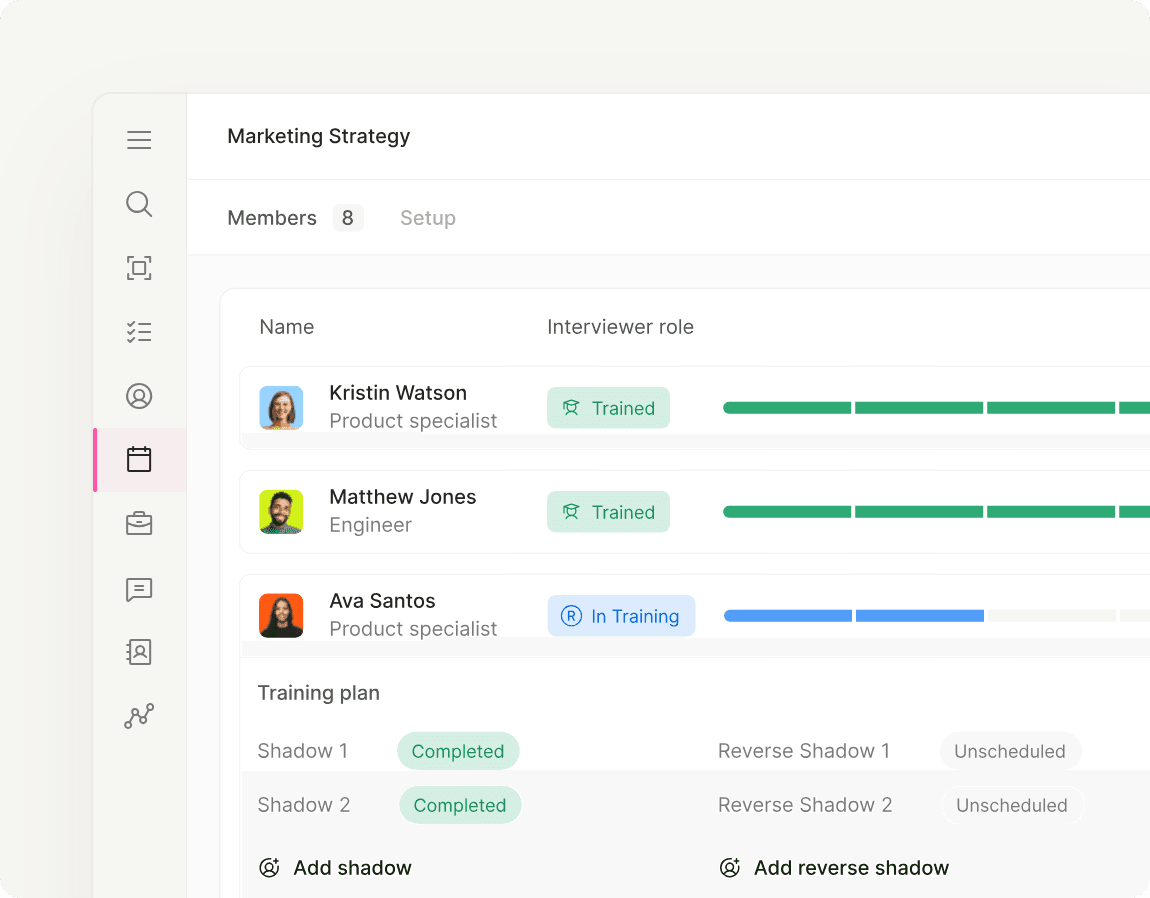
An interviewer pool in ModernLoop: who is trained, who is in training, and each trainee’s shadows and reverse shadows.
With Zero Click Scheduling, the request can start itself: when a candidate moves to the onsite stage in your ATS, the scheduling link and candidate email go out automatically.
Common interview loop mistakes
- Too many interviews. Every extra interview should add a signal you can’t get elsewhere. If two interviewers would ask the same questions, cut one.
- Untrained interviewers. A loop is only as consistent as its least prepared interviewer. Train new interviewers through shadows and reverse shadows before they run an interview alone.
- Burning out your best people. The same five senior people end up in every loop. Track interviewer load and spread it across the pool.
- No breaks, or the wrong order. Back-to-back for five hours tests stamina, not skill.
- A new link for every interview. Candidates shouldn’t hunt through five invites. One link, one itinerary.
- A debrief nobody booked. Feedback goes stale fast. Book the debrief with the loop.
Interview loop design template
Copy this table into your planning doc and fill one row per interview. For a ready-made version with time slots and an itinerary, use the interview schedule template.
| Interview | Competency | Interviewer pool | Format and length | Trainee? |
|---|---|---|---|---|
| Hiring manager | Role fit, motivation | Hiring manager, backup manager | Video, 45 min | No |
| Skills interview | Core craft | Trained senior team members | Video or onsite, 60 min | Shadow welcome |
| Problem solving | Open-ended problem, trade-offs | Trained staff-level interviewers | Onsite, 60 min | Reverse shadow |
| Cross-functional | Collaboration | Partner-team interviewers | Video, 45 min | Optional |
| Values | How the candidate works | Trained interviewers outside the team | Video, 45 min | Shadow welcome |
Schedule your next loop in minutes
ModernLoop schedules panels and onsite loops from your ATS, balances interviewer load and trains new interviewers as it goes. See how it handles panel, onsite and superday scheduling, or read the superday guide.
Related articles

Multi-interviewer, multi-time-zone loops, scheduled in one go.
What a superday is and how to run one without a coordinator meltdown.