GuideCandidate fraud and deepfake interviews: how to spot and prevent them
Contents

Short answer
Candidate fraud is when an applicant misrepresents who they are or what they can do: a stolen or synthetic identity, a stand-in or coached interviewee, or a deepfake on video. No single sign proves it. Make it hard with layered process controls: consistent panels, live-video practices, identity checks at the legally right moments and verification through your existing vendors.
What is candidate fraud?
Candidate fraud, or interview fraud, covers any attempt to get hired under false pretenses. The common forms:
- Embellished credentials. Degrees, titles or employers that don’t check out.
- Proxy interviews. Someone other than the applicant takes the interview, or a different person shows up to do the job.
- Off-camera coaching. Answers fed in real time by another person or a tool.
- Stolen or synthetic identities. Real people’s details, or invented ones, used to apply.
- Deepfakes. Video or voice altered to impersonate someone in a live interview.
These aren’t hypothetical. In June 2022, the FBI’s Internet Crime Complaint Center (IC3) warned of an increase in complaints about deepfakes and stolen personal information used to apply for remote and work-from-home jobs, including IT, programming, database and software roles. Complaints described interviews where the candidate’s lip movements didn’t match the audio, and background checks that found an applicant’s details belonged to someone else. More recent FBI warnings about North Korean IT workers describe paying facilitators to take job interviews on a worker’s behalf.
None of this means treating every candidate as a suspect. The FBI itself warns that aggressive controls carry “unusually high risks of generating false positives” that could harm legitimate employees and filter out qualified applicants. The goal is a process that makes fraud hard without making honest candidates jump through hoops.
Candidate fraud warning signs by stage
Treat these as reasons to look closer, not verdicts. Each has innocent explanations on its own; what matters is a cluster, or a sign that repeats across stages.
| Stage | Warning signs | What to do |
|---|---|---|
| Application | Résumé and online profiles that don’t match; contact details shared with other applicants; brand-new professional profiles | Note it, and plan to verify history directly with employers and schools |
| Recruiter screen | Camera off without a reason; vague answers about past work; a location that doesn’t match the application | Expect video from every candidate, with an accommodation path; probe for specifics |
| Skills interviews | Audio out of sync with lip movement; long pauses before polished answers; eyes tracking something off-screen | Use planned follow-up probes; ask the candidate to walk through their own past work |
| Panel or onsite | A different-seeming person, voice or skill level between rounds; resistance to any in-person step | Keep one interviewer constant across rounds and compare notes |
| Offer and checks | Background-check details that belong to someone else; equipment requested at an address that isn’t on their ID | Pause and escalate; ship equipment only to the verified address |
| First weeks | The person on camera isn’t the person you interviewed; unexpected remote-desktop tools on work devices; frequent changes to bank details or addresses | Escalate to security and HR together |
Identity checks at the right moments
Identity verification is an employer process with legal timing rules, so agree on it with HR and legal before you change anything. A sensible sequence:
Timing matters. E-Verify’s rules say employers must not use it to pre-screen applicants, and USCIS requires Form I-9 Section 2 within three business days of the employee’s first day of work for pay. If you add an identity step before the offer, keep it to confirming identity, apply it to every candidate at that stage and have counsel approve it. The FBI notes that steps such as E-Verify and live verification raise friction for fraudulent workers, and its July 2025 guidance recommends verifying prior employment and education directly with employers and schools.


Consistent interviewer panels and live-video practices
Most of what helps is good interviewing anyway. These practices make fraud harder without making the process hostile.


Recording consent and interview policy
Recording interviews can help reviewers and deter fraud, but consent rules differ by state and country, and AI note-takers raise the same questions. Before you record:
- Write a policy: which interviews you record, who can watch and how long you keep recordings.
- Tell candidates in advance, in the invite, and get consent where the law requires it.
- Decide what happens if a candidate declines to be recorded, and make sure it doesn’t count against them.
- Store recordings with your other candidate data, under the same access controls and retention rules.
Have legal sign off on the policy and the candidate notice. A recording you weren’t allowed to make is a bigger problem than the one you were trying to solve.
What to do when you suspect candidate fraud
Write the playbook before you need it, owned jointly by recruiting, security and legal. The FBI’s October 2026 guidance makes the same point: IT, HR, security and management each see different signals, and combining them improves detection.
Where interview scheduling data helps
Your scheduling records are a quiet source of evidence. A consistent loop record shows who met the candidate, when, on which link and in what order, which is the first thing an investigator will ask for. Patterns show up there too: repeated last-minute reschedules, requests to change the meeting platform, the same contact details on several applications.
Build that consistency into the process: interview plans that keep one interviewer constant across rounds, invites that always carry the same video link, interviewer notes attached to each interview, and reschedules logged with who asked for them. None of this detects fraud by itself. It gives the people who can detect it something to work with.
Where ModernLoop fits
ModernLoop is interview scheduling software, not an identity-verification or fraud-detection tool. What it does is keep the interview process consistent: interview plans with suitable interviewers for every loop, one consistent Zoom or Google Meet link for every interview, a private Slack channel per candidate where the interview team can compare notes, and Reporting & Dashboards to follow up on declined or rescheduled interviews. Identity checks, background checks and security reviews stay with the teams and vendors you already trust.
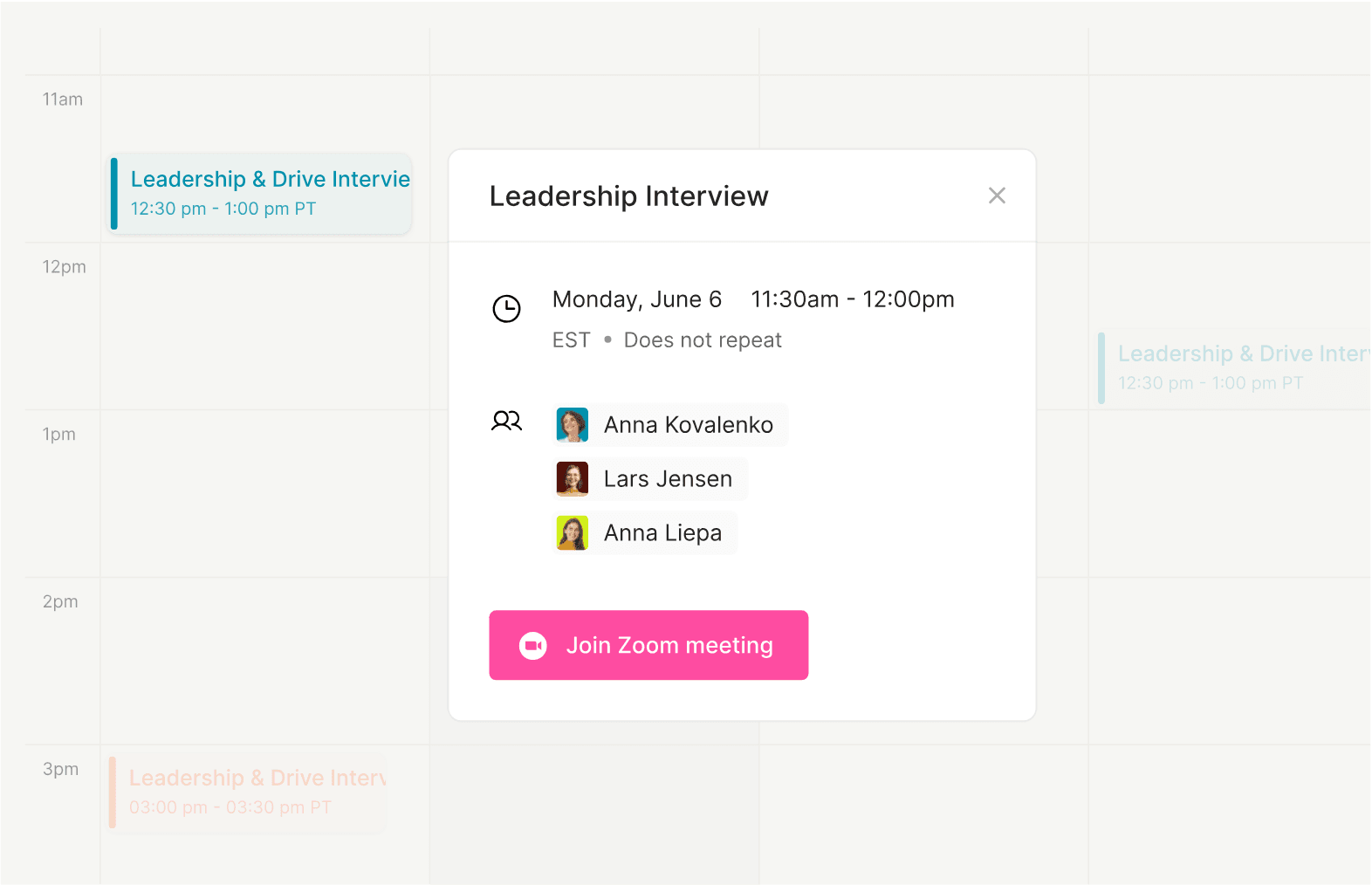
ModernLoop gives every interview one consistent Zoom or Google Meet link, shown here on a Leadership Interview event.
Sources
Legal points are summarized for orientation, not as legal advice. All sources checked October 22, 2026.
Related articles

Plans, kits, sample questions and a four-point rating scale.
Steps, timing rules, templates and how to handle cancellations.