GuideHow to hire faster: the speed levers at every stage of hiring
Contents
Short answer
To hire faster, find where candidates wait, then remove the wait. Much of the delay sits between steps rather than in them: approvals, slow scheduling, feedback that arrives days late and offers stuck in sign-off. Measure stage durations and time to schedule, fix the slowest stage first, and automate the handoffs your team does by hand.
Why hiring speed matters
Every day a role stays open, the work waits and the team covering it gets more tired. Every day a candidate waits, they keep interviewing elsewhere. Speed isn’t about rushing decisions. It’s about not making good candidates sit in a queue while calendars line up.
The benchmarks give a sense of scale. SHRM’s 2026 benchmarking data puts the median time to fill for nonexecutive roles at 39 calendar days, from requisition opened to offer accepted. In 2025, organizations with 5,000 or more employees took 61 days for nonexecutive roles, and SHRM found they allocate nearly twice as much time to getting positions approved, getting jobs posted and conducting interviews (SHRM, 2025).
The market makes it sharper in some industries. In August 2026, there were more than three job openings for every hire in finance and insurance:
| Industry | Job openings | Hires in the month | Openings per hire (calculated) |
|---|---|---|---|
| Finance and insurance | 353,000 | 110,000 | 3.2 |
| Information (technology) | 123,000 | 44,000 | 2.8 |
| Health care and social assistance | 1,359,000 | 703,000 | 1.9 |
| Manufacturing | 522,000 | 332,000 | 1.6 |
| Professional and business services | 1,186,000 | 935,000 | 1.3 |
Source: U.S. Bureau of Labor Statistics, Job Openings and Labor Turnover Survey, August 2026 (preliminary). Openings per hire is openings divided by hires in the month.
median time to fill for nonexecutive roles
SHRM, 2026 Recruiting Executives Benchmarking
median time to fill for nonexecutive roles at organizations with 5,000+ employees
SHRM, 2025 Recruiting Executives Benchmarking
Where hiring time goes, stage by stage
SHRM breaks time to fill into seven stages, from requisition approval to offer acceptance. Use the same stages for your own data: once you can see the median days in each, the slowest stage is usually obvious.
| Stage | Starts and ends | Where the time goes | Median days |
|---|
Stage definitions follow SHRM’s 2025 Recruiting Executives Benchmarking data brief.
Speed levers, stage by stage
One or two changes per stage, aimed at the waiting rather than the assessment.


Scheduling: the hiring delay you can measure
Most stages are hard to time precisely. Scheduling isn’t. Every interview has a timestamp for when it was requested and one for when it was confirmed, and the gap between them is time to schedule. It’s pure waiting: nobody learns anything about the candidate while their calendar and five interviewers’ calendars are lined up.
It also compounds. A process with five interviews and a two-day wait before each one has spent ten days on logistics before anyone makes a decision. Cut the wait in half and you’ve taken five days out of time to hire without removing a single interview.
To measure it, take the median hours from request to confirmed interview, split by interview type, and watch the slowest 10%.
Interviewer capacity: the constraint behind slow loops
When loops take weeks to book, the cause is often the interviewer bench, not the coordinator. If only three people can run the system design interview and each will do two a week, you can run six onsite loops a week at most, however fast you schedule.
Widen the bench before you need it. Train new interviewers through shadows and reverse shadows, set weekly load limits so the people on the bench stay willing, and track trained coverage for each interview type alongside time to schedule. A bench of eight shared fairly moves faster than a bench of three who are always booked.
Quick wins this week vs structural changes
Quick wins you can make this week
- Put a scheduling link in the first email to every candidate you screen.
- Set a 24-hour feedback deadline and remind interviewers the same evening.
- Book the debrief when you book the loop.
- Cut one interview from your longest loop if two interviews test the same thing.
- Give coordinators one queue for scheduling requests instead of email, chat and hallway asks.
Structural changes for this quarter
- Start scheduling automatically when a candidate moves stage in your ATS.
- Build trained interviewer pools for every interview type, and grow them through shadowing.
- Pre-approve headcount and compensation bands with the hiring plan.
- Move final rounds to a single day where you can.
- Review stage durations and time to schedule every week, in the same meeting.
What not to cut
Speed is only a win if the decisions hold up. Keep structured interviews with clear rubrics, keep every interview that tests something the role needs, and keep written feedback before the debrief. Cut the waiting, the duplicate interviews and the manual handoffs instead. A fast, well-run process that ends in an evidence-based decision is the one candidates remember for the right reasons.
What is hiring velocity?
Hiring velocity is how quickly candidates move from application to accepted offer. Teams measure it with time to hire and the median days candidates spend in each stage. Some also track throughput, such as hires or completed interviews per recruiter per month, which shows capacity rather than speed.
Keep the two apart. A team can raise throughput by adding recruiters while every candidate still waits just as long. Velocity improves only when the waiting gets shorter.
Hiring speed audit checklist
Run it on one role family. If you can’t answer a question, that’s the first finding.

Take the manual steps out of scheduling with ModernLoop
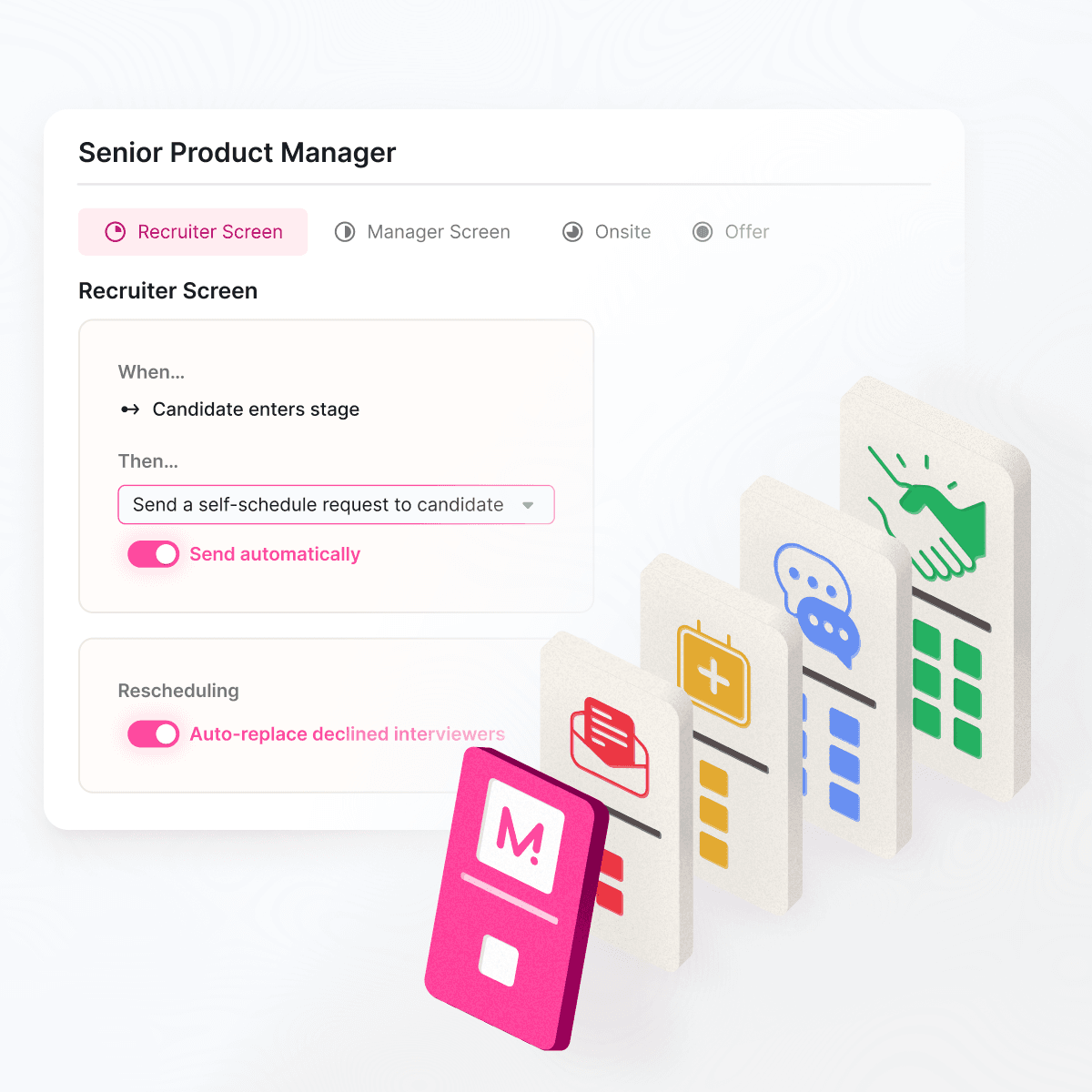
ModernLoop works on the stage you can measure. Zero Click Scheduling sends interview requests and scheduling links automatically as candidates move stages in your ATS, and candidates pick a time from the interviewers’ availability. For panels and onsite loops, the scheduling algorithm uses candidate availability, interviewer availability and interviewer load to propose multiple complete schedules, so no single busy interviewer holds up the loop.
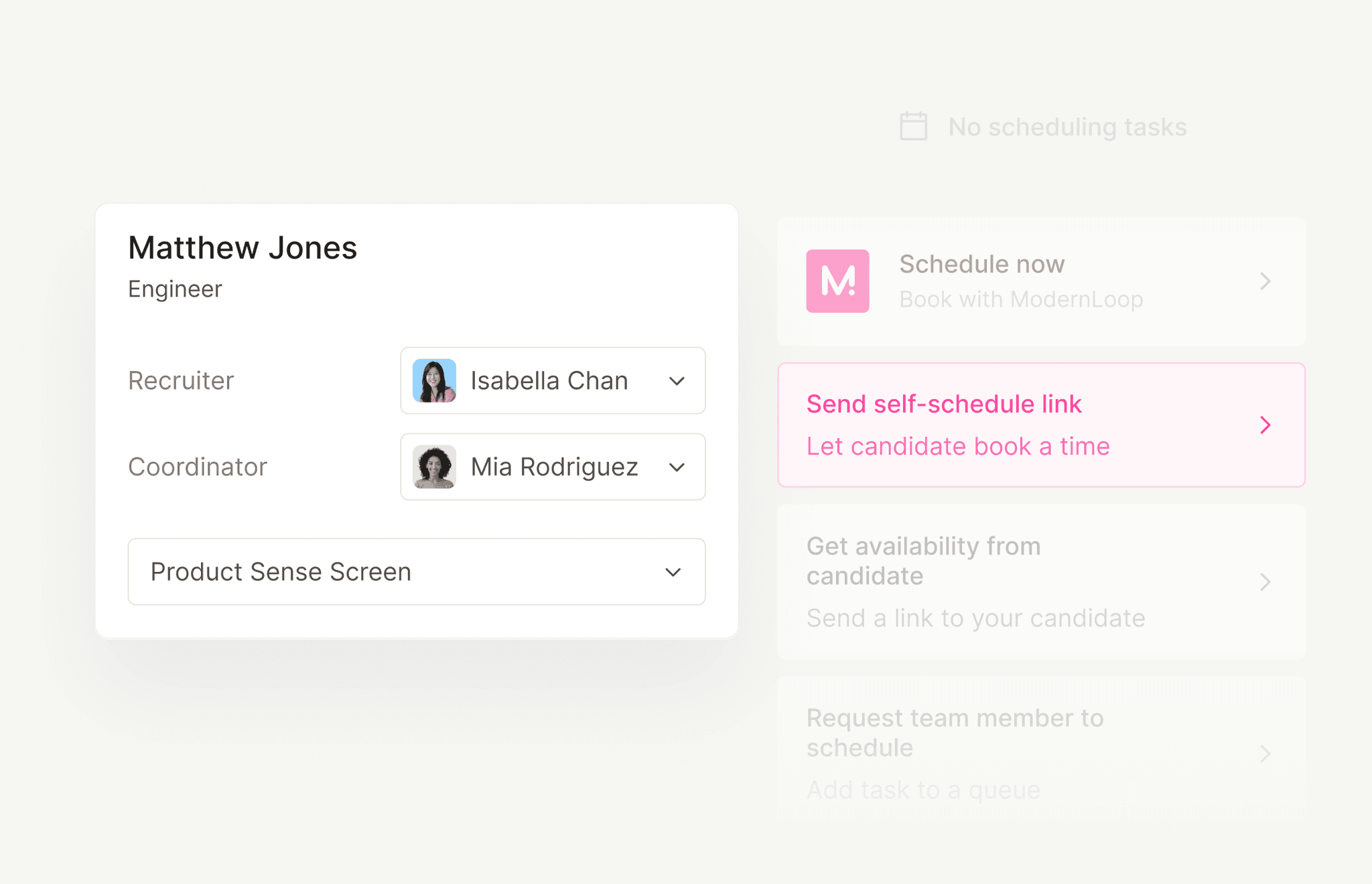
Requesting an interview in ModernLoop: schedule now, send a self-schedule link, get the candidate’s availability, or add a task to a coordinator’s queue.
Scheduling Queues put every pending request in one place, with the recruiter’s notes on urgency, and Interviewer Training adds trainees as shadows and reverse shadows, so your interviewer pools grow while you hire.
Sources
- SHRM, “2026 Recruiting Executives Benchmarking: Attracting Critical Talent,” shrm.org/topics-tools/research/recruiting-benchmarking (checked October 22, 2026)
- SHRM, “2025 Recruiting Executives Benchmarking: Insights to Maximize Recruitment” (data brief), shrm.org/content/dam/en/shrm/research/2025-recruiting-benchmarking-report.pdf (checked October 22, 2026)
- U.S. Bureau of Labor Statistics, Job Openings and Labor Turnover Survey, August 2026 (preliminary)
- ModernLoop, “How to Calculate Time-to-Schedule to Drive More Efficient Interviews,” modernloop.com/blog/how-to-calculate-time-to-schedule/ (read October 22, 2026)
Related articles

Sixteen recruiting KPIs with formulas, benchmarks and a weekly dashboard spec.
Reference points for time to schedule, reschedules and interviewer load.