GuideStructured interviews: a practical guide to plans, kits and questions
Contents
Short answer
A structured interview asks every candidate for a role the same job-related questions, in the same order, and scores each answer against the same rating scale. Questions come from the role’s competencies, follow-up probes are planned in advance, and trained interviewers score independently before they discuss. Structure makes interviews fairer, more consistent and more predictive of job performance.
What is a structured interview?
The U.S. Office of Personnel Management (OPM) describes structured interviews as ones that use rules for eliciting, observing and evaluating responses. In plain terms: you decide before the interview what you’ll ask, what you’ll listen for and how you’ll score it, and you hold every candidate to the same plan.
Most structured questions come in two forms. Behavioral questions ask about the past (“Tell me about a time you…”), on the principle that past behavior predicts future behavior. Situational questions pose a realistic scenario (“What would you do if…”), which helps when candidates have less directly comparable experience.
Structure comes in degrees. A semi-structured interview fixes the topics but lets interviewers improvise the questions; a fully structured one fixes the questions, the probes and the rating scale.
Structured vs unstructured vs semi-structured interviews
| Dimension | Structured | Semi-structured | Unstructured |
|---|---|---|---|
| Questions | The same questions, in the same order, for every candidate | Same topics; interviewers choose the questions | Whatever the interviewer asks |
| Follow-ups | Planned probes | Some planned, some improvised | Improvised |
| Scoring | A rating scale with anchors for each question | A shared scorecard, loosely applied | An overall impression |
| Comparing candidates | Like for like | Partly comparable | Hard to compare |
| Interviewer training | Required | Recommended | Often skipped |
| Best for | Hiring decisions where consistency and fairness matter | Early conversations, senior roles with varied paths | Informal chats, not decisions |
What research says about structured interviews
Decades of selection research point the same way. In 2022, Sackett, Zhang, Berry and Lievens re-examined meta-analytic estimates of how well common selection procedures predict job performance, in the Journal of Applied Psychology. They concluded that earlier corrections had overstated validity for many procedures, with mean estimates falling by .10 to .20 points, and that structured interviews emerged as the top-ranked selection procedure.
OPM’s guidance agrees: higher structure is associated with higher validity, rater reliability and rater agreement, and with less adverse impact. Structure won’t rescue a badly designed loop, but it’s the best-supported way to run the interviews inside one.
How to build an interview plan and an interview kit
Two documents do the work. The interview plan covers the whole loop: which interviews, in what order, who runs each and which competency each one owns. The interview kit covers one interview: the questions, probes, rating scale and notes template an interviewer needs to run it the same way every time.
OPM’s advice on rating scales maps onto steps 3 and 4: decide how many proficiency levels you want, write behavioral or situational examples for each level, and decide how each question will be scored. Keep the scorecard in your ATS, where the hiring decision is made.


Sample structured interview questions with a rating scale
Here are four competencies from a typical professional role, each with one behavioral question, what a strong answer covers and a four-point scale. Adapt the anchors to your level and function.
| Competency | Question | What good looks like | Rating anchors (1 to 4) |
|---|---|---|---|
| Problem solving | “Tell me about a problem you solved where the cause wasn’t obvious at first.” | Frames the problem, tests hypotheses, uses evidence, explains trade-offs | 1 Describes the outcome, not the thinking 2 One approach, little evidence 3 Clear reasoning backed by evidence 4 Weighs alternatives and says what they’d do differently |
| Collaboration | “Describe a time you disagreed with a colleague about how to do the work. What happened?” | Seeks the other view, separates people from the problem, lands a decision | 1 Blames or avoids 2 Resolves it only by escalating 3 Finds common ground 4 Improves the outcome and the working relationship |
| Ownership | “Tell me about something you owned that went wrong. What did you do?” | Takes responsibility, acts quickly, fixes the cause, not just the incident | 1 Deflects responsibility 2 Fixes the incident only 3 Fixes it and keeps people informed 4 Changes the process so it doesn’t recur |
| Communication | “Walk me through how you explained a complex decision to people who disagreed with it.” | Tailors the message, checks understanding, handles pushback | 1 Repeats the same explanation 2 Explains clearly, but one-way 3 Adapts to the audience 4 Adapts, checks understanding and earns buy-in |
Calibration and interviewer training
A rating scale only works if interviewers read it the same way. Two habits get you there. First, train interviewers through shadows and reverse shadows: the trainee watches an experienced interviewer, then runs the interview while the experienced interviewer watches and gives feedback. Second, calibrate: have the panel score the same sample answer independently, compare scores and talk through the gaps until a 3 means the same thing to everyone.
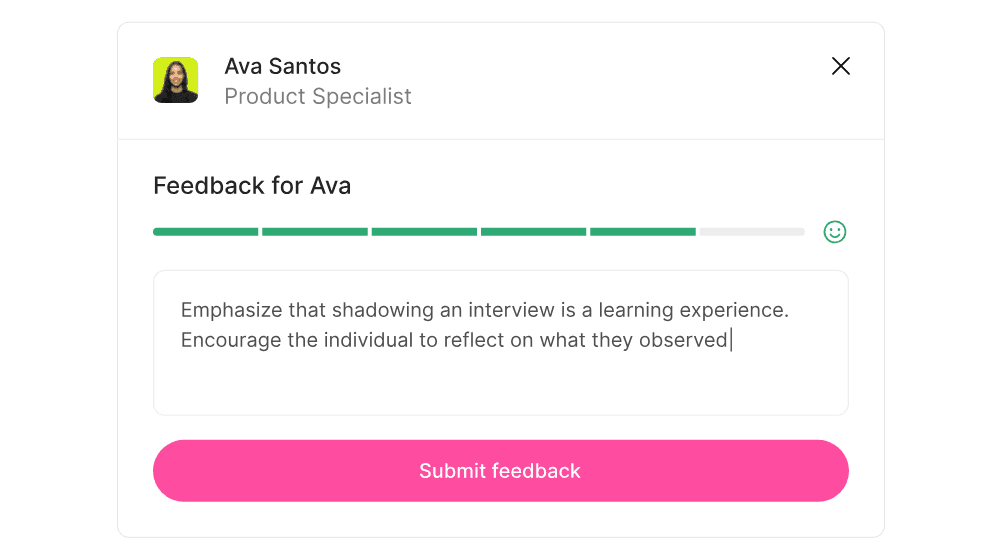
Feedback and progress tracking for each trainee in ModernLoop Interviewer Training.
Recalibrate when you change the questions, add interviewers or notice one interviewer scoring far from the rest. And score before the debrief. OPM describes panels that rate individually first, then discuss to resolve significant scoring discrepancies; independent scores, written down before anyone talks, are what make the structure count.
Common structured interview mistakes
- Questions nobody mapped. If you can’t say which competency a question tests, cut it.
- Anchors made of adjectives. “Strong communicator” isn’t an anchor. “Adapts the explanation and checks understanding” is.
- Skipping the probes. The first answer is rehearsed. The follow-ups are where you learn something.
- Talking before scoring. Once the most senior person shares an opinion, independent scores stop being independent.
- Untrained interviewers. One interviewer improvising undoes the structure for everyone else.
- A kit that never changes. Review questions and anchors at least once a year, and whenever the role changes.
Run structured loops consistently with ModernLoop
A structured interview is only consistent if the right trained people run it every time. In ModernLoop, you set up each loop as an interview plan with its suitable interviewers, so every candidate for a role gets the same sequence. ModernLoop tracks which interview types each interviewer is trained for, and the scheduling algorithm balances interviewer load so your best interviewers don’t burn out.
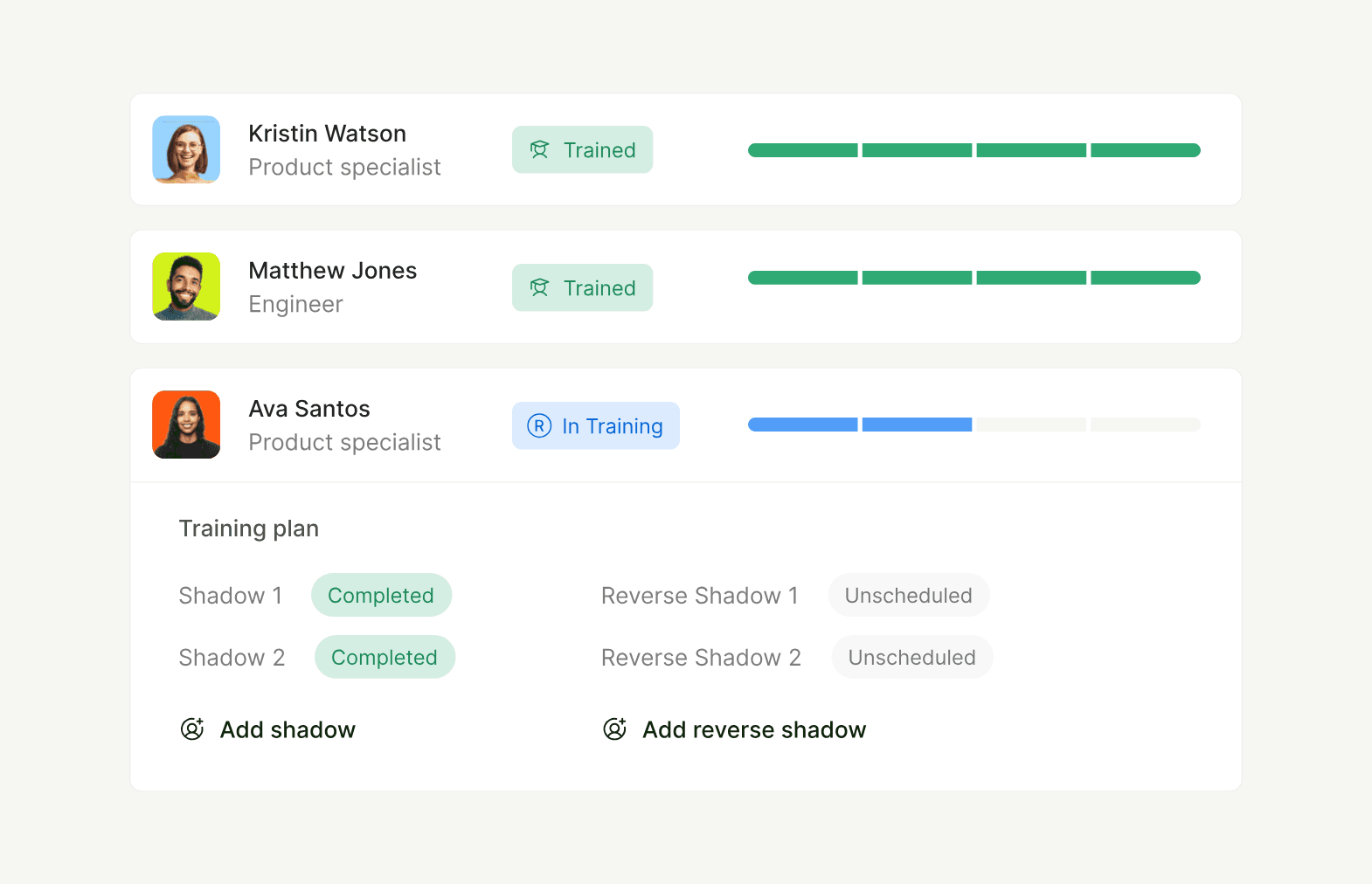
With Interviewer Training, trainees are added automatically as shadows and reverse shadows according to their progress and availability, and you decide how many of each a program needs. Trainees and trainers assess performance, add comments and move a trainee to the next stage right in Slack. For how the interviews fit together, see what is an interview loop.
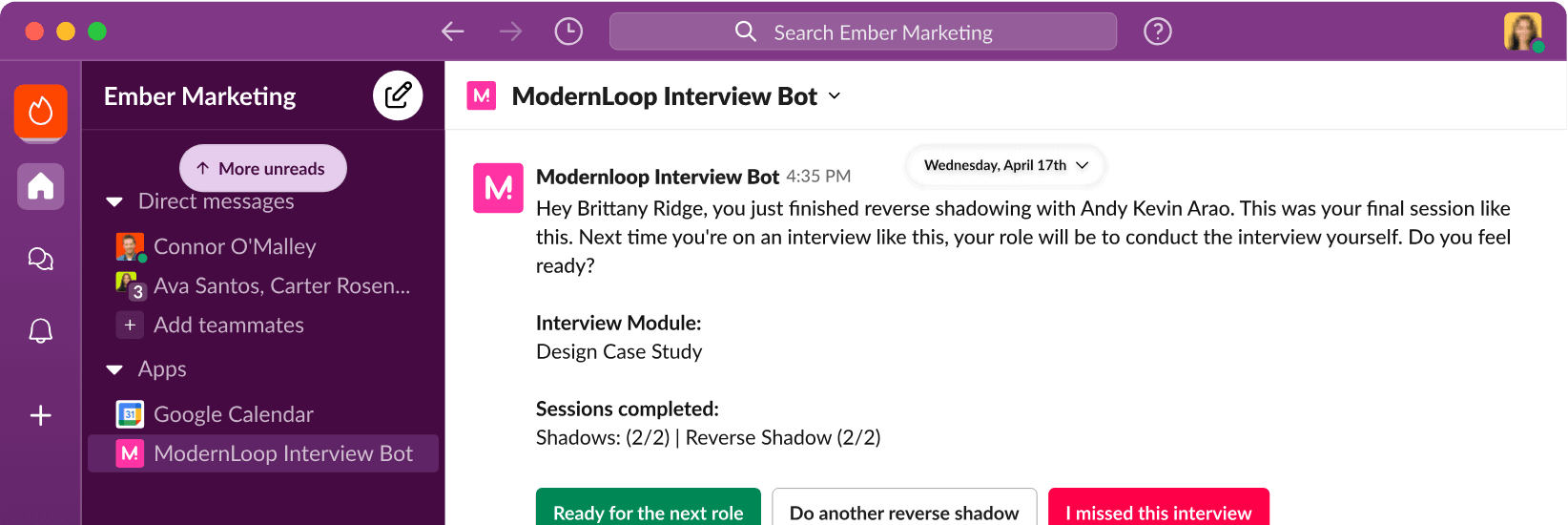
Interviewer Training in Slack: ModernLoop’s Interview Bot asks whether a trainee is ready for the next role.
Sources
All sources checked October 22, 2026.
Journal of Applied Psychology
Related articles

Warning signs by stage, and the process controls that prevent fraud.