GuideSuperday interviews: what a superday is and how to run one
Contents
Short answer
A superday is a final-round interview day where a candidate meets several interviewers back to back, usually alongside other candidates interviewing the same day. Investment banks, consulting firms and other employers that hire in cohorts use superdays to run the final round for many candidates at once, then decide together.

If you’re a candidate: what to expect at a superday
A superday is the last step before an offer. You’ll have several interviews in a row, each with a different interviewer or pair, and each testing something different: technical knowledge, how you work through a problem or case, and how you’d fit the team. Some firms add a modeling test, a case study or a lunch with junior staff. You’ll usually meet other candidates on the day. Be friendly: people notice how you treat everyone, including the person at the front desk.
Before the day, ask the recruiter for:
- The itinerary: times, interviewer names and the format of each interview.
- The address or video links, and who to contact if something goes wrong.
- Whether there’s a test or case, and what you need to bring or install.
- The dress code and when to arrive.
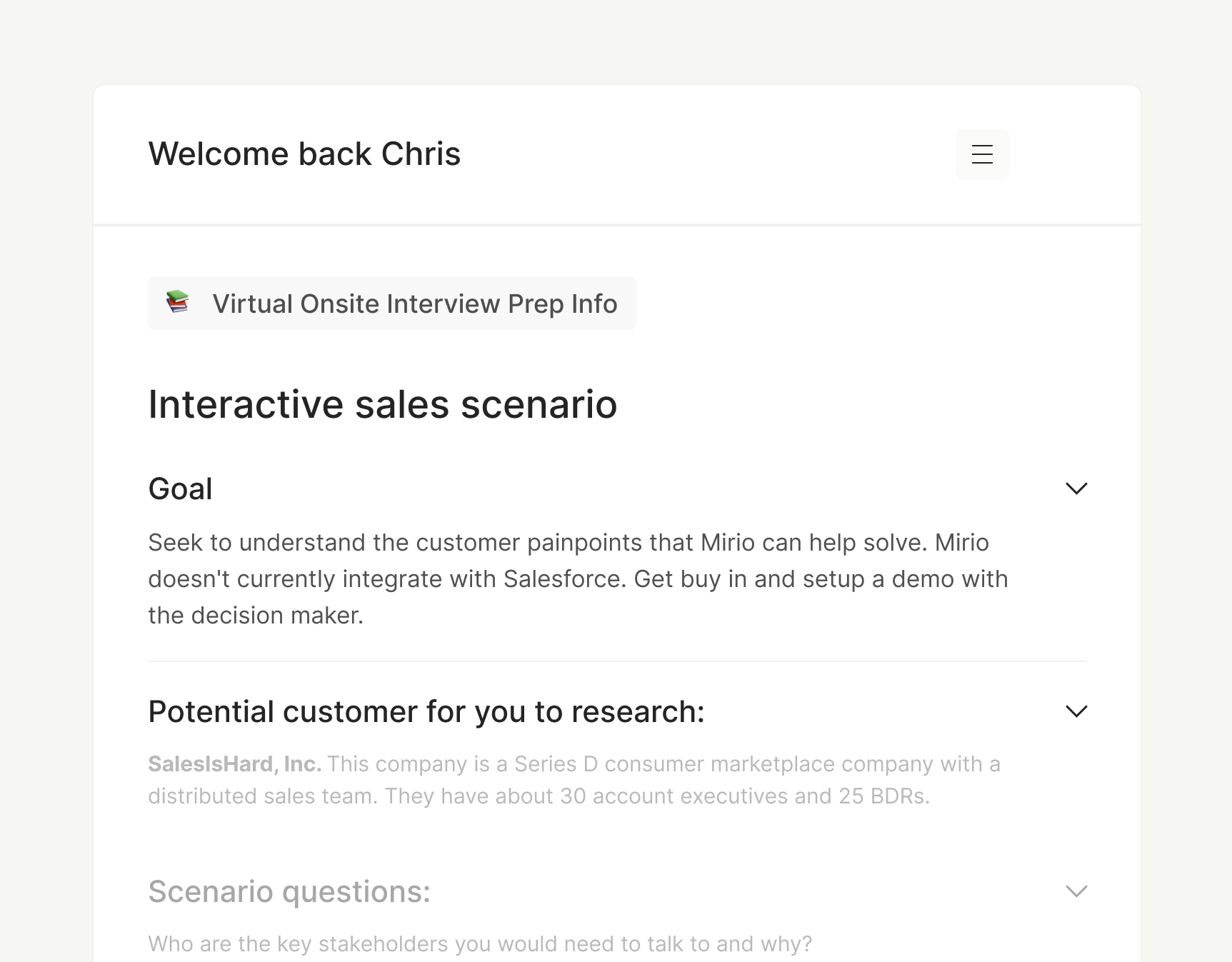
Interview prep in ModernLoop’s Candidate Portal: a virtual onsite page with the goal of a sales case exercise and a company to research.
On the day, treat every conversation as part of the interview and keep your story consistent: the interviewers compare notes afterward. At the end, ask when you’ll hear back.
Superday vs a regular final-round interview
A normal final round is built around one candidate: you find a day that works for them and for four or five interviewers. A superday flips that. The employer fixes the date, books a pool of interviewers for the whole day, and runs many candidates through the same set of interviews. It’s common wherever hiring happens in classes: analyst and associate programs in banking, consulting, graduate schemes and campus hiring.
When it works, the format is efficient and fair. Every candidate gets the same interviews with calibrated interviewers, and the team decides with all the evidence in one room. When it fails, it’s almost always logistics: a missing interviewer, a double-booked room, a candidate dialing in from the wrong time zone. The rest of this guide is about the logistics.
How to plan a superday, step by step
Six steps, in order. Most superday problems start with skipping the first two.


Superday capacity math: candidates, interviews and interviewers
Every superday is a capacity problem. Work it out on paper before you send a single invite. The example uses 24 candidates and four interviews each.
| Input or output | Formula | Worked example |
|---|---|---|
| Candidates (C) | Input | 24 |
| Interviews per candidate (I) | Input | 4 |
| Interviews to staff | C × I | 96 |
| Interview slots in the day (S) | Length of the interview block ÷ (interview length + reset time) | 8 |
| Interviews running at once | (C × I) ÷ S | 12, so 12 rooms or video links |
| Most interviews one person runs in a day (L) | Input: your load limit | 4 |
| Interviewers needed | (C × I) ÷ L | 24 |
| Backups | At least one per interview type | 4 |
| Shadows | At most one trainee per room, if training is part of the plan | Up to 12 |
Two traps. First, interview types aren’t interchangeable. If only six people are trained to run the technical interview and every candidate needs one, the technical interview sets your ceiling: six interviewers × four interviews = 24 candidates. Second, load builds across a season. Someone who runs four interviews at every superday in October won’t be volunteering in November. Track load across dates, not just within one day.
Sample superday itinerary
A one-day, four-interview superday for one candidate group. Run two or three groups in parallel and rotate interviewers by slot, so every candidate meets every interview type once.
| Time | What happens | Who | Notes |
|---|---|---|---|
| 8:30 | Welcome and overview of the day | Recruiter, all candidates | Check phone numbers; confirm everyone has the itinerary |
| 9:00 | Interview 1: technical | Trained technical interviewer | 40 minutes, plus 5 to reset |
| 9:45 | Interview 2: behavioral and fit | Senior team member | Shadow welcome |
| 10:30 | Break | None | Water, restrooms, a minute to breathe |
| 10:45 | Interview 3: case or modeling exercise | Two interviewers | Hand out materials at the start |
| 11:30 | Interview 4: hiring manager | Hiring manager or group head | Leave time for the candidate’s questions |
| 12:15 | Lunch with junior team members | Analysts or associates | If it isn’t assessed, tell candidates so |
| 13:00 | Close and next steps | Recruiter | Say when candidates will hear back |
| 15:00 | Debrief (interviewers only) | Interviewers, recruiter, hiring manager | Written feedback due before it starts |
Rooms, links and logistics
Decide early who moves: the interviewers or the candidates. Onsite, interviewers usually keep a room and candidates rotate, so rooms map to interviewers. On video, the simplest pattern is the reverse. Each candidate keeps one link for the whole day and interviewers join in turn, so nobody hunts for a new link every 45 minutes.
Either way, keep one source of truth: a grid showing every candidate, interviewer, slot and room or link. When someone drops out, the coordinator swaps in a backup and updates the grid, the calendar invites and the candidate in one move. If those three ever disagree, the candidate finds out first.
Interviewer pools, training and calibration
Superdays run on interviewer pools: groups of people trained to run each interview type. Pools let you staff a day without leaning on the same senior names, and they make backups possible.
Superdays are also a good place to train new interviewers, within limits. Add a shadow to some rooms, never all of them, and tell the candidate a second person is observing. Before the season starts, run a calibration session so interviewers score the same answer the same way. It makes the debrief shorter and the decisions fairer.
The superday debrief
Book the debrief when you book the day. Ask for written feedback before anyone speaks, so the first confident opinion doesn’t set the tone, then go candidate by candidate against the rubric. Agree in advance what happens to borderline candidates: a second conversation, a waitlist or a no. Then tell candidates when they’ll hear back, and keep the promise.
Running superdays through a campus recruiting cycle
In campus recruiting, one superday becomes a season of them. Plan the dates against the academic calendar, space them so the same interviewers aren’t needed every week, and reuse one set of templates for the itinerary, briefs and emails, so each day runs smoother than the last. Rotate pools and watch interviewer load across the whole season: the people who interview at every event in the first month won’t be there for the last one.
Superday coordinator checklist
Eight things to have done before the first candidate arrives.

Superday itinerary email template
Send it once the schedule is final. One message, everything in it.
Superday itinerary
Send as soon as the schedule is final
Subject: Your superday with {Company} on {date}
Hi {Candidate first name}, Thanks for confirming. Here is your schedule for {date} (all times {time zone}): {time} Welcome and overview with {Recruiter name} {time} {Interview 1} with {Interviewer name, title} {time} {Interview 2} with {Interviewer name, title} {time} Break {time} {Interview 3} with {Interviewer names} {time} {Interview 4} with {Interviewer name, title} {time} Close and next steps {Arrival instructions, or: You’ll use the same video link all day: link} {Anything to prepare, for example a calculator for the modeling exercise} If anything goes wrong on the day, call or text {Coordinator name} at {phone number}. We’re looking forward to meeting you. {Recruiter name}
Run superdays in ModernLoop
ModernLoop schedules group, panel, virtual and onsite interviews, so a superday is one plan instead of dozens of separate bookings. The scheduling algorithm uses candidate availability, interviewer availability and interviewer load to propose complete schedules. Coordinators adjust them in a side-by-side calendar view with drag and drop, and when an interviewer can’t make it, ModernLoop helps find the best replacement.
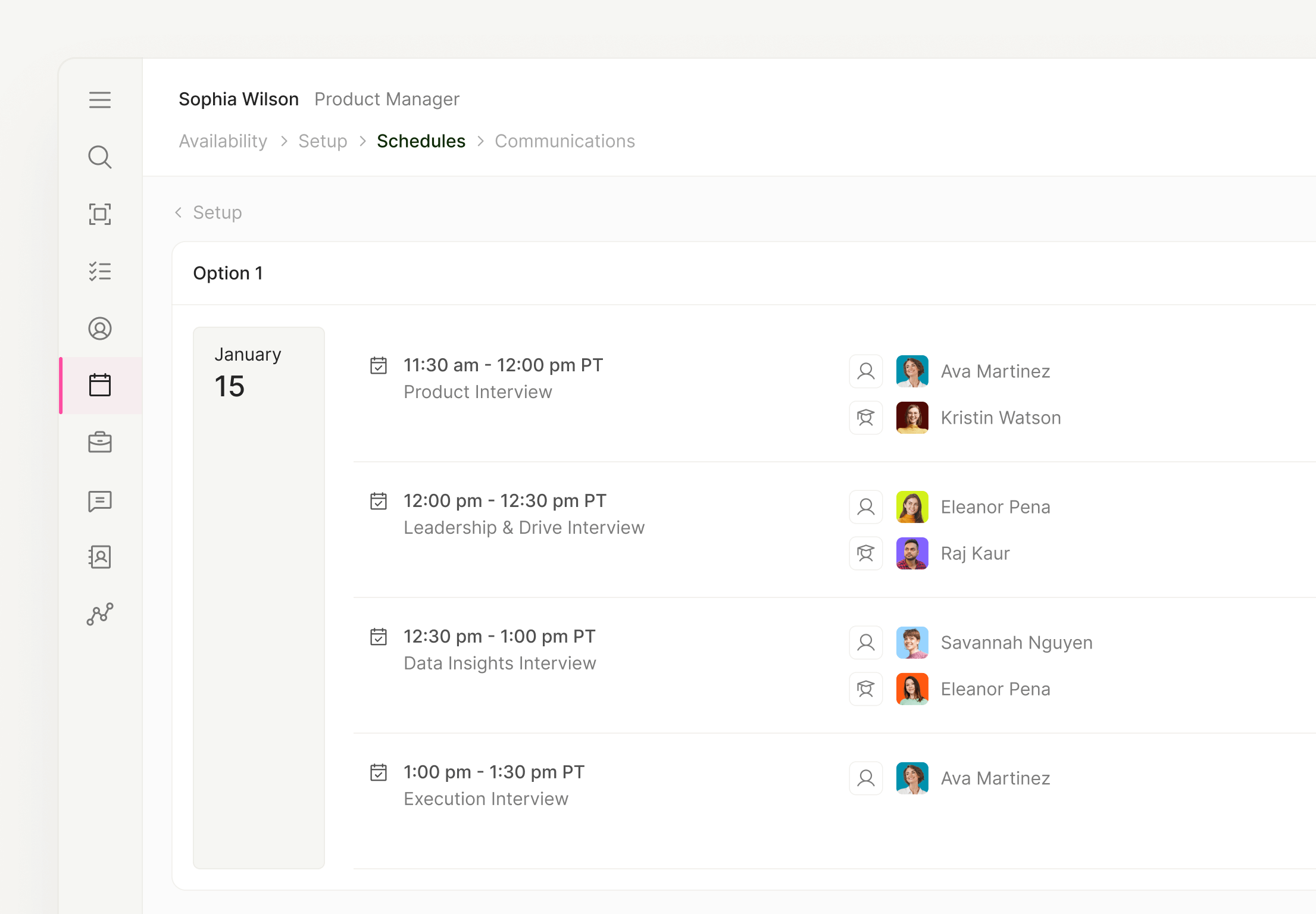
A proposed schedule in ModernLoop: one of the complete schedules the algorithm suggests, with four back-to-back interviews and their interviewers.
Interviewer Training adds trainees as shadows and reverse shadows when they’re ready. Candidates see their whole day in a branded Candidate Portal, with one consistent Zoom or Google Meet link, and the interview team for each candidate can get a private Slack channel. See how we handle panel, onsite and superday scheduling, and how financial services recruiting teams use ModernLoop.
Related articles

Multi-interviewer, multi-time-zone loops, scheduled in one go.
Analyst classes, superdays and trained interviewer pools, without the spreadsheet.