GuideWhat does a recruiting coordinator do?
Contents

Short answer
A recruiting coordinator runs the logistics of hiring. They schedule interviews, keep candidates informed, prepare interviewers, keep the ATS up to date and make sure every interview happens on time, with the right people and the right link. On enterprise teams, coordinators are the operations engine behind recruiters, hiring managers and interviewers.
What is a recruiting coordinator?
A recruiting coordinator turns a hiring plan into interviews that actually happen. Recruiters find and close candidates, hiring managers decide, interviewers assess. The coordinator makes sure all of them are in the right place at the right time with the right information, and that the candidate has a clear, professional experience from first screen to final round.
On small teams, recruiters coordinate their own interviews. At enterprise scale, coordination becomes its own function: a team of coordinators, often organized by business unit or region, led by a coordination lead or recruiting operations manager, working from shared queues and shared standards. It’s also where many recruiting careers start.
Recruiting coordinator responsibilities
Seven responsibilities show up in almost every recruiting coordinator job description.


A week in the life of a recruiting coordinator
No two weeks match, but this is a fair picture of a coordinator supporting a busy engineering and sales hiring plan.
| Day | Morning | Afternoon | What usually goes sideways |
|---|---|---|---|
| Monday | Clear the weekend’s scheduling requests; confirm this week’s onsite loops | Build next week’s panels; send itineraries | Two interviewers declined over the weekend |
| Tuesday | Reschedules, replacements and candidate questions | Interviewer prep and feedback reminders for Monday’s interviews | A candidate booked the right time in the wrong time zone |
| Wednesday | Onsite day: greet candidates, run the room, swap in a backup interviewer | Debrief logistics; update the ATS | The old video link is still in the candidate’s calendar |
| Thursday | Recruiter sync on priorities and urgent requests | Plan a superday or hiring event; book rooms | A hiring manager wants the whole loop moved to tomorrow |
| Friday | Tidy the ATS; chase missing feedback | Review the week (time to schedule, reschedules, interviewer load) and plan the next | The same three interviewers are on every loop again |
Notice the pattern: the planned work fits in the mornings, and the afternoons absorb whatever moved. The best coordinators protect time for the planned work and build systems for the rest.

A scheduling task assigned in ModernLoop: the email gives the coordinator the candidate, job, stage and status.
Recruiting coordinator skills
- Organization and prioritization. Dozens of open requests, each with its own urgency, and a clear sense of which comes first.
- Calendar fluency. Time zones, working hours, the meetings people will and won’t move, and how Google Calendar and Microsoft Outlook behave.
- Clear writing. Candidate emails that answer the question before it’s asked.
- Discretion. Candidate identities, compensation and confidential searches stay confidential.
- Calm under change. Plans change hourly. The candidate shouldn’t feel it.
- Systems sense. Comfort with the ATS and scheduling tools, and the curiosity to make them work better.
- Polite firmness. Telling a senior leader their hold has to move, and making it easy for them to say yes.
How recruiting coordinators are measured
Good coordination is mostly invisible, so teams measure it through outcomes. The usual scorecard:
- Time to schedule: how long candidates wait between a request and a confirmed interview.
- Reschedule and no-show rates, split by who caused them.
- Candidate satisfaction after the interview stage.
- Requests handled and the age of open requests, as a view of workload rather than a race.
- Interviewer load and declines, because a coordinator who books the same three people every time is borrowing from next quarter.
Our guide to recruiting metrics has the formulas.
Recruiting coordinator job description template
Copy it, replace the bracketed fields and cut anything that doesn’t apply to your team.
Recruiting coordinator job description
Edit the bracketed fields, then post
Job title: Recruiting Coordinator, {team, region or business unit}
About the role {Company} is hiring a Recruiting Coordinator to run interview logistics for our {team or region} hiring. You’ll schedule interviews from phone screens to onsite loops, give every candidate a clear and timely experience, and keep our interviewers prepared and our ATS accurate. You’ll report to the {Recruiting Coordination Lead or Recruiting Operations Manager} and work closely with recruiters and hiring managers.
What you’ll do
• Schedule interviews across calendars and time zones, including panels, onsite loops and hiring events
• Be the candidate’s point of contact for logistics: confirmations, itineraries, reminders and reschedules
• Prepare interviewers with the right details and materials, and remind them to submit feedback
• Keep candidate stages and interview records in {ATS} accurate
• Run interview days: rooms, video links, visitor access and travel
• Track scheduling metrics and suggest improvements to the process
What you’ll bring
• {1 to 2} years in recruiting coordination, scheduling-heavy operations or executive support
• Excellent organization and written communication
• Confidence with Google Calendar or Microsoft Outlook, and with {ATS}
• Discretion with confidential candidate information
• Calm, friendly problem solving when plans change
Nice to have
• Experience with interview scheduling software
• Campus, superday or high-volume hiring experience {Pay range and benefits, as your local pay transparency rules require} {Location and work arrangement}
Recruiting coordinator salary
The U.S. Bureau of Labor Statistics doesn’t publish pay for recruiting coordinators as a separate occupation. The closest occupation it tracks is human resources specialists, which explicitly includes recruitment specialists, or recruiters. Treat those figures as a reference point for the wider recruiting field, not as a coordinator salary: coordinator pay varies with level, location and company size.
According to the BLS Occupational Outlook Handbook, the median annual wage for human resources specialists was $75,940 in May 2025. The lowest 10% earned less than $47,180 and the highest 10% more than $128,720, and BLS projects employment in the occupation to grow 6% from 2025 to 2035 (BLS, 2026).
How to become a recruiting coordinator
There’s no single route in. Coordinators come from executive support, customer service, events, operations and administrative roles, and straight from college as a way into recruiting. What hiring managers look for is evidence that you can juggle many moving parts without dropping one, write clearly and stay pleasant under pressure.
If you’re applying, show it. Describe a time you ran a complicated calendar or event, name the tools you’ve used, and make the application itself tidy. Knowing an ATS helps, but most teams will teach the system. They can’t teach the instinct to check the time zone twice.
Recruiting coordinator career path
Coordination is a strong place to start because you see the whole hiring process at once. Four common directions from here:
- Senior coordinator, then coordination lead. Own executive interviews, complex loops and campus programs, then lead a coordination team.
- Recruiting operations. Systems, process, interviewer programs and reporting. Coordinators who learn the data and the tools are well placed here.
- Recruiting or sourcing. Move from running the process to owning searches.
- Candidate experience and programs. Own candidate surveys, hiring events and interviewer training.
Whichever way you go, the skill that transfers is the same: you know how hiring actually works, where it breaks and how to fix it.
Tools recruiting coordinators use
The ATS is the system of record. Scheduling software is where most of the coordinator’s day happens. If coordinators spend their time copying details between the two, fix that first.
| Tool | What coordinators use it for | Examples |
|---|---|---|
| Applicant tracking system (ATS) | Candidate stages, interview records, feedback | Workday, Greenhouse, Lever, Ashby, SmartRecruiters, iCIMS |
| Interview scheduling software | Finding times, building panels, invites and candidate emails, reschedules | ModernLoop |
| Calendar | Availability, holds and rooms | Google Calendar, Microsoft Outlook |
| Video | Virtual interviews | Zoom, Google Meet, Microsoft Teams |
| Messaging | Interview-team updates and quick swaps | Slack, Microsoft Teams |
| Coding and assessment tools | Technical interviews | CoderPad, HackerRank, CodeSignal, Codility |
How ModernLoop helps recruiting coordinators
ModernLoop is built around the coordinator’s day. With Scheduling Queues, recruiters send requests from a Chrome extension inside the ATS, with notes on urgency and the interviewers they need, and coordinators work every pending request from one queue. Zero Click Scheduling sends interview requests and scheduling links automatically when candidates move stages, so routine interviews book themselves.
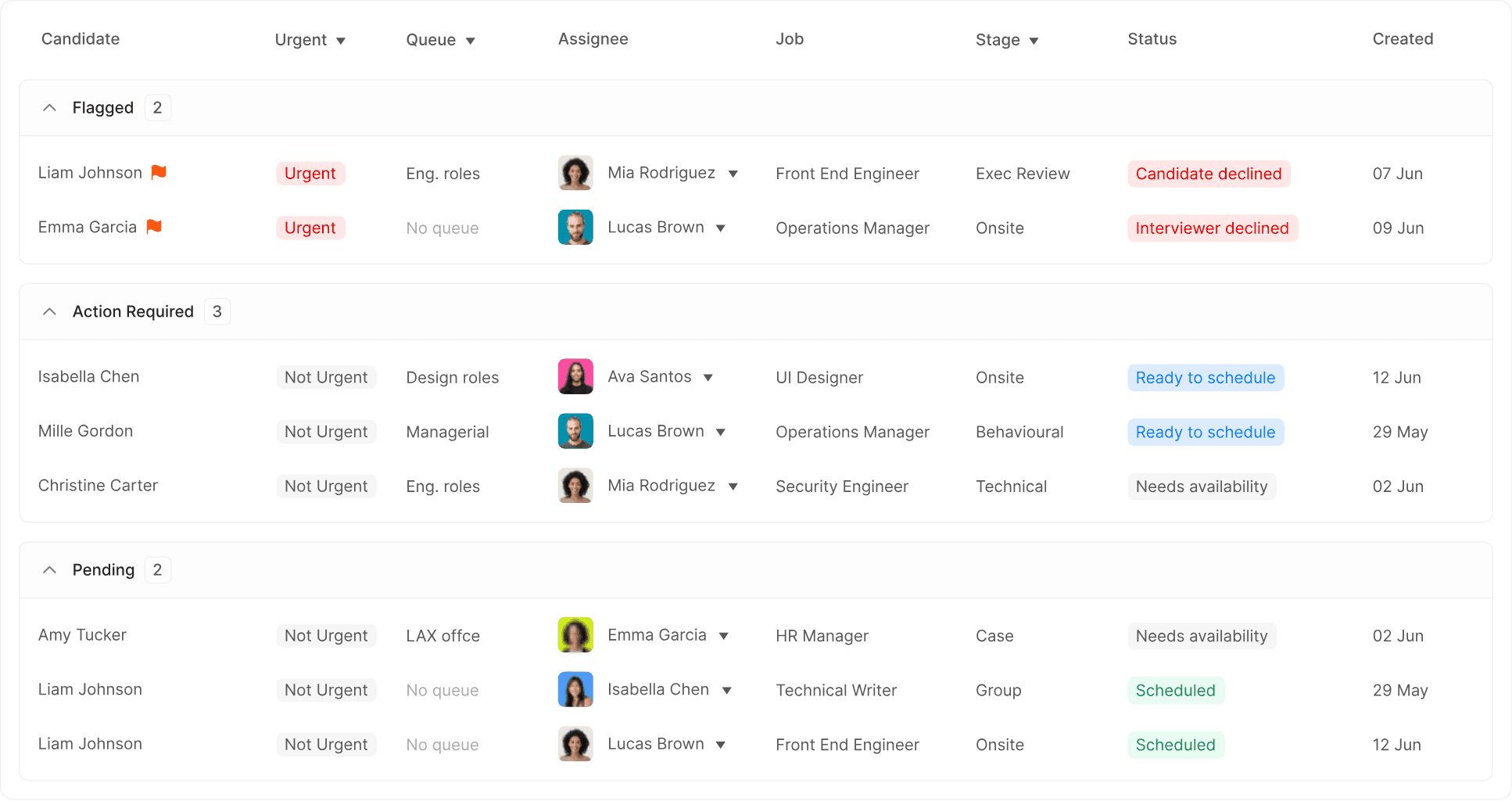
Scheduling Queues in ModernLoop: every pending request in one place, with its urgency, queue, assignee, job, stage and status.
For panels, the scheduling algorithm proposes multiple schedules that respect availability and interviewer load, and when an interviewer drops out, ModernLoop helps find the best replacement. Interviewer Training adds shadows automatically, and candidates get a branded Candidate Portal with their schedule and one consistent video link. See what ModernLoop does for coordinators.
Sources
- U.S. Bureau of Labor Statistics, Occupational Outlook Handbook, “Human Resources Specialists,” bls.gov/ooh/business-and-financial/human-resources-specialists.htm (page last modified August 27, 2026; checked October 22, 2026)
Related articles

Copy-ready emails for requests, confirmations, reschedules and reminders.
What a superday is and how to run one without a coordinator meltdown.