
Featured definitionWhat is an interview loop?
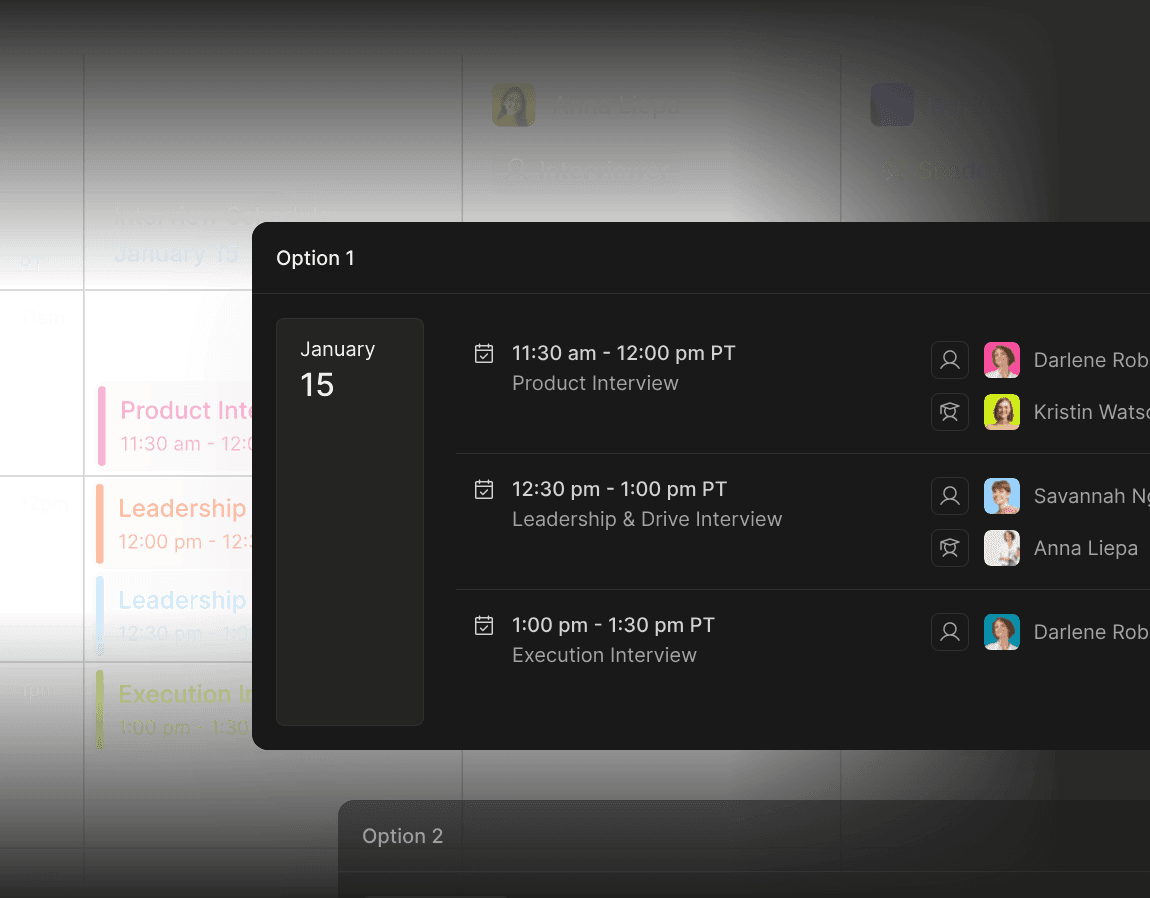
An interview loop is the full set of interviews a candidate completes for one role, planned as a single block. Each interviewer assesses different skills, then the team compares notes and decides together.
The full definition covers loop interview vs interview loop, an example loop, how to design one, and a free loop design template.
A

The system of record for hiring. An ATS holds your jobs, candidates and applications, tracks each candidate’s stage, and stores interview feedback and offers. Scheduling, sourcing and assessment tools usually connect to it rather than replace it.
C

Letting candidates book their own interview from a link that shows open times, instead of trading availability over email. The times come from the interviewers’ calendars, so whatever the candidate picks is already free on your side. It removes the back-and-forth; the trade-off is less control over exactly who interviews when.
I

The full set of interviews a candidate completes for one role, planned as a single block and usually forming the final round. Each interviewer assesses different skills, then the team compares notes and decides together.

Spreading interviews fairly across everyone qualified to run them, so the same few people don’t end up in every loop. Teams typically set a cap, such as a maximum number of interviews per person each week, and send new interviews to whoever has room. It protects interviewers from burnout and keeps interview quality steady.
O

An onsite interview is the final-round block of interviews at the employer’s office, often half a day or a full day. A virtual onsite is the same loop run over video: the candidate stays put while interviewers rotate through, ideally on one link that works all day.
P

An interview in which several interviewers meet the candidate together in one session, each usually covering a different area. Panels spare the candidate repeat conversations but are harder to schedule, because every panelist has to be free at the same time.
R

The person who keeps the interview process running: scheduling interviews, booking rooms and video links, briefing interviewers and keeping candidates informed. On many teams one coordinator supports several recruiters and handles every reschedule.
S

Two steps in interviewer training. In a shadow, the trainee sits in on an interview and observes a trained interviewer. In a reverse shadow, the trainee leads while the trained interviewer observes and gives feedback, before the trainee interviews alone.

An interview in which every candidate for a role is asked the same planned questions and scored against the same rubric. Structure makes answers comparable across candidates and interviewers, so decisions rest on evidence rather than impressions.

A final-round interview day, common in finance and consulting recruiting, where a group of candidates each complete several back-to-back interviews on the same day. For the employer it’s a scheduling feat: many candidates, many interviewers, one day.
T

The number of calendar days from opening a job requisition to the day a candidate accepts the offer. It’s the business view of hiring speed: how long a seat stays empty, which is why finance and hiring managers watch it.

The number of days from when a candidate enters your process, by applying or being sourced, to when they accept your offer. It measures how long the candidate waits on you, so scheduling delays show up here.

The time from an interview request, or the stage change that triggers it, to a confirmed interview on the calendar. Averaged across interviews, it shows how much of your hiring timeline is spent waiting on calendars.
V
Virtual onsite: see Onsite interview and virtual onsite.

